Sunday October 24, 1976 Revisited - A Memory of a Lifetime
An essay by Peter Canning
on running the first 5-Boro NYC Marathon
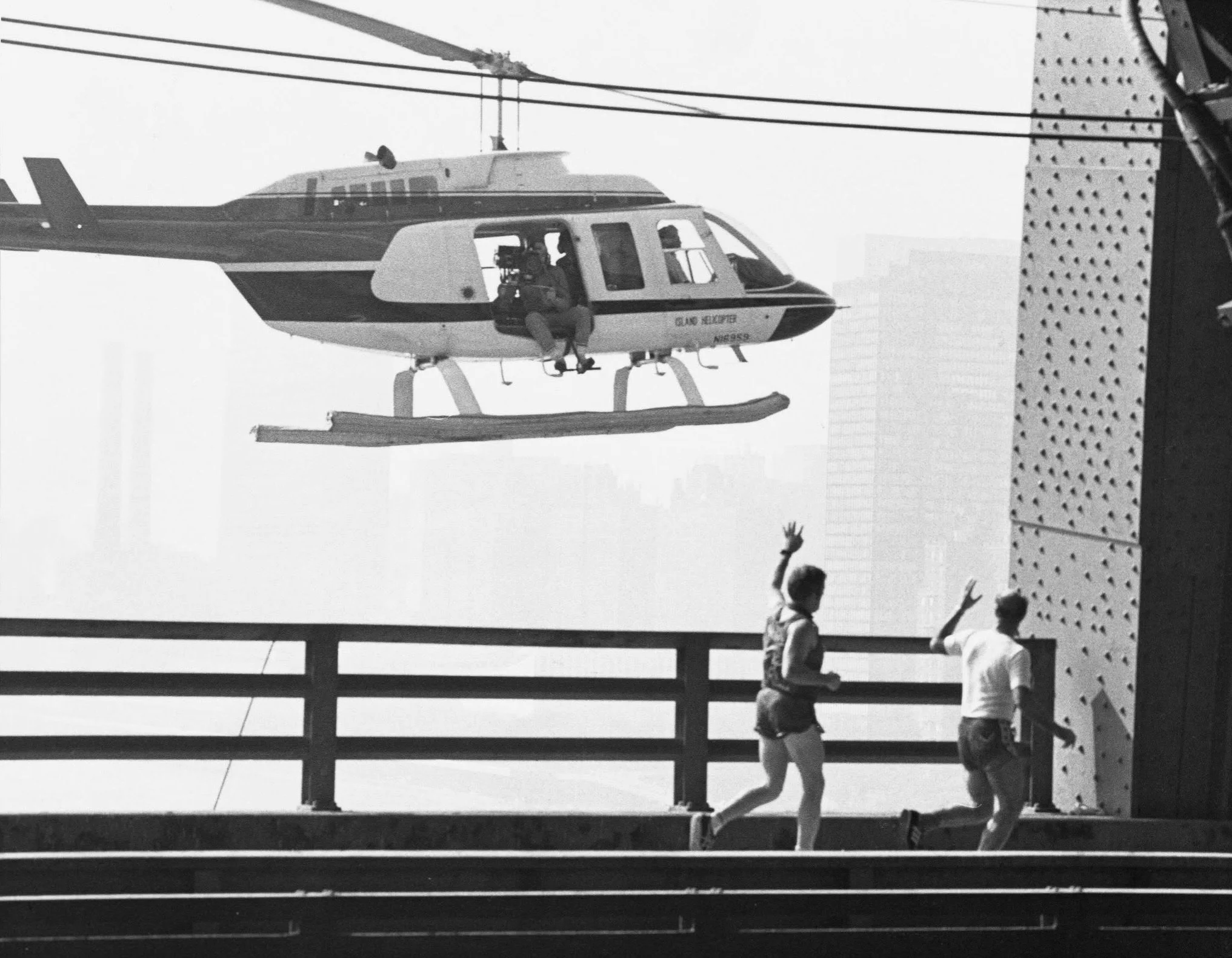
Verrazano-Narrows Bridge during the 1976 NYC Marathon (Photo Credit: NYRR posted on Facebook)
As we approach the 50th anniversary of the 5 Boro New York City Marathon, Linda Chan thought that, since I ran the very first one back in 1976, it would be fun to hear what it was like “way back when”.
It’s funny: some moments I can remember vividly while others are completely lost to me. Unfortunately, most of the actual race is a blur to me now. But I know for sure that I would not have run that marathon had I not joined PPTC. Fortunately I did and now I have a memory of a lifetime.
Virtually everything has changed since the 1976 race. Only two things remain the same: it still is 26 miles 385 yards and it still is the best marathon in the world!!
Here are some fun facts about the 1976 race:
The entry fee was $5.00 (about $30.00 in today’s dollars),
You could enter the day of the race,
There were 2,090 entrants - 2,002 men and 88 women.
There were 1,539 finishers - 1,476 men and 63 women. Last year there were 59,219 finishers - 31,925 men, 27,156 women and 138 non-binary.
Bill Rodgers and Frank Shorter received $3,000 “under the table” appearance money. Today both the men and women winners get $100,000.
There were 12 PPTC finishers in 1976. Last year there were 466.
Backdrop to the Race
New York City in 1976 was a hot mess. Urban blight and crime were widespread. Inflation and reduced services had the city reeling.The federal government refused to offer a bailout. The iconic Daily News headline blared: FORD TO CITY. DROP DEAD.
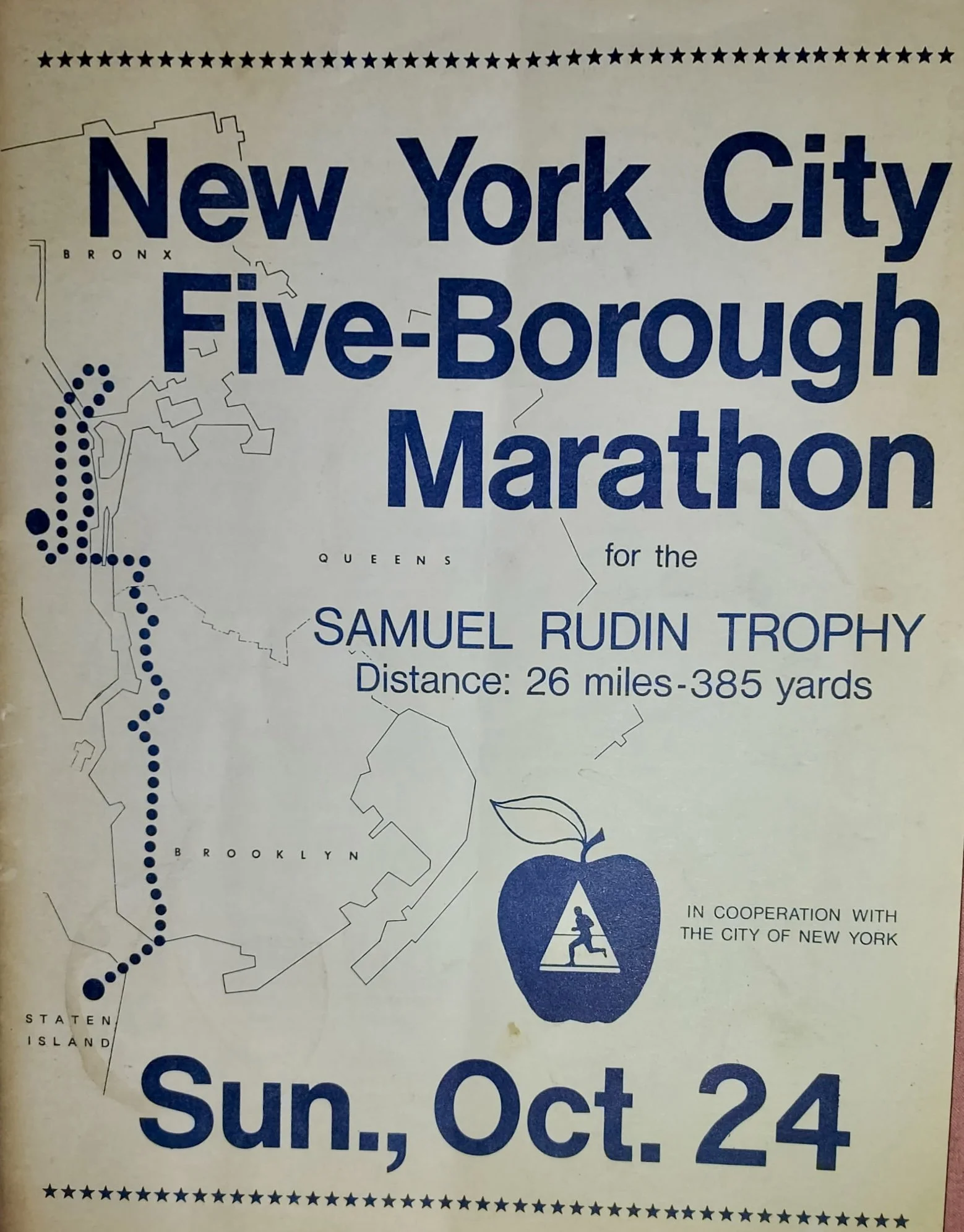
Against this backdrop the idea for a 5 Boro race celebrating the country’s Bicentennial was hatched. Five men were instrumental in getting it done. Ted Corbitt, legendary NYRRC founder and Olympic marathoner, conceived the idea. George Spitz, political gadfly and dedicated runner, pitched it to Manhattan Borough President Percy Sutton who, along with George Hirsch, former chair of the NYRRC, secured the financing. Fred Lebow, NYRRC president, hyped and hustled it and secured the star power duo of Frank Shorter and Bill Rodgers as participants.
Thus the first 5 Boro New York City Marathon was born with the hope that it would help the city regain its civic pride. Sunday October 24th was chosen as the date.
However, there’s a sixth man that needs to be recognized. How can you have a 5 Boro race without a 5 Boro course? Enter Harry Murphy, PPTC’s founder and my mentor. Although Harry had help, he is credited with being the prime architect of the course. More on the course later.
My Start in Running
In January 1976 I had just turned thirty and was approaching 200 pounds. My doctor suggested that I would be better off if I shed some weight. Since it was winter and I thought then that nobody in their right mind ran outside in the winter, I joined the Prospect Park Y and started to run on their track overlooking the basketball court. It was challenging. Not just because I was terribly out of shape but also because there were 22 laps to the mile. So you got dizzy before you got tired. With the help of a hand counter I gradually worked my way up to 3 miles 3 days a week. I was starting to feel fit.
In May to test my newfound fitness I entered a 5 mile race. So on race day off I went to Central Park in my Keds Knockaround sneakers, gym shorts and old t-shirt to “win” the Greater NYC YMCA 5 Mile Run. After all, I could run 3 miles in 25 minutes. Thirty eight minutes and 48 seconds later and a mid pack finish I humbly trudged home to Brooklyn and slept for three hours. But I was hooked on road racing.
About this time news of the 5 Boro race had begun to get out and I thought, maybe just maybe, I could do it. I did realize I would have to train for it. But how? The YMCA’s director suggested I join a group called the Prospect Park Track Club. Now I was really on my way.
From PPTC to October 24th
On a Saturday morning in early June I made my way to Prospect Park’s 9th Street entrance to join the Prospect Park Track Club. I was nervous. They were experienced runners. Would they want to spend the time to help a new runner? Would they even want a newbie?
Fortunately the first person I met was Harry Murphy, PPTC’s founding father. Harry warmly greeted me and introduced me to the six or so other runners. My guess is that PPTC had at that time about 25 to 30 members. Harry who then was in his early sixties and had been a nationally ranked runner took me under his wing. With his guidance and encouragement I gradually worked myself up to 10 mile runs on the weekends. To this day I will never forget Harry’s generosity of spirit. The fact I am still running today is because Harry was there for me all those many years ago.
Club President Bob Muller became my runner guru. Bob taught me to run in an upright, relaxed position with my eyes focused straight ahead. He, like Harry, offered advice and encouragement and by the end of July got my mileage up to 35 to 40 miles per week.
Most of my training was long slow distance or LSD. My speed work consisted primarily of running PPTC’s three Summer Speed Program races (we now have seven). Back then they were a once around the park run and, if you wanted your time, you looked up at the finish line clock. After the race Harry would take me over to Gary Muhrcke’s van, give Gary a nod and Gary would give me a $2 discount on a pair of running shoes that cost $20 or so. Gary was the winner of the first NYC marathon run in Central Park in 1970. He went on to open the Super Running Shops that are still in business today. He was New York’s own “Shoe Dog”.
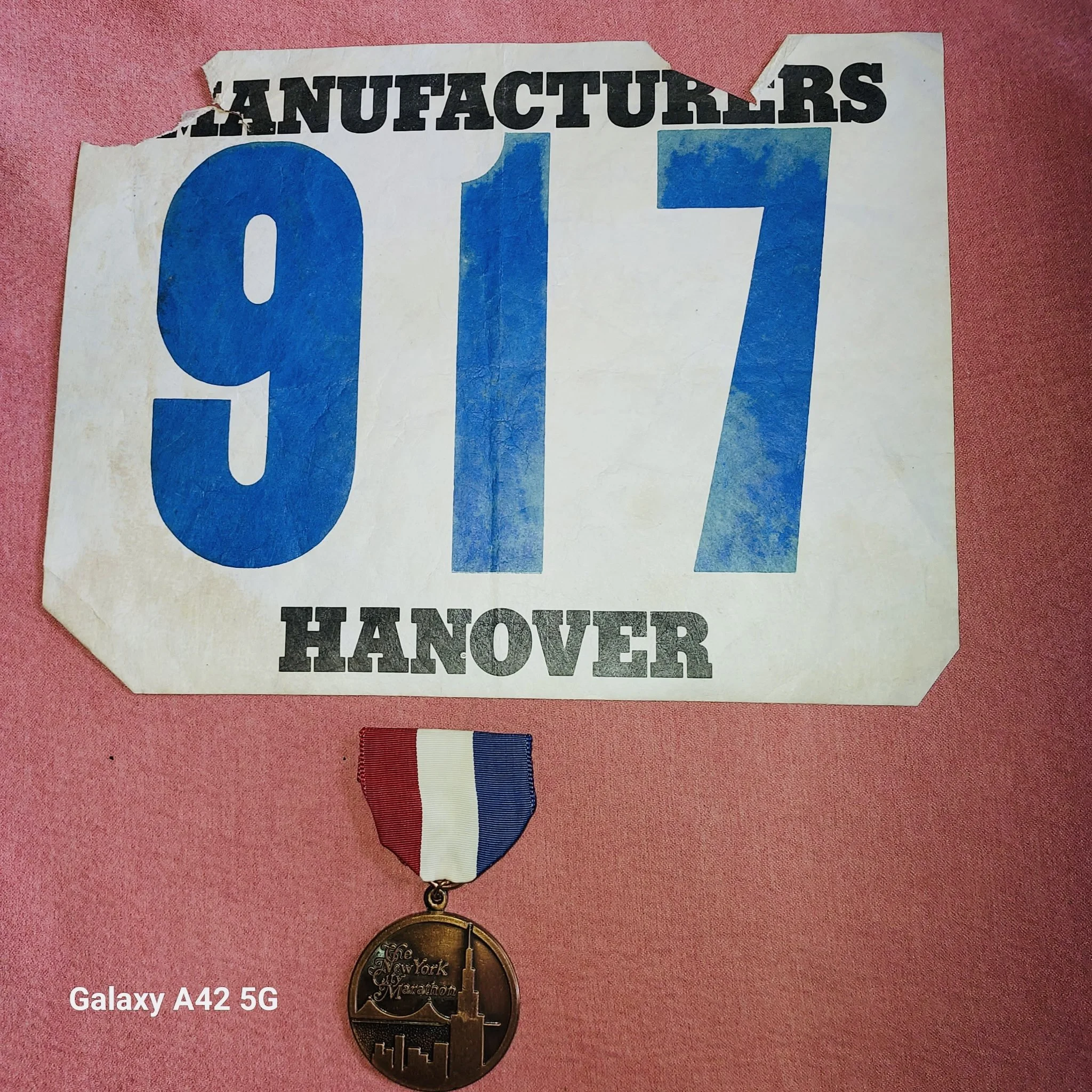
Around this time I filled out the entry form, wrote out a $5 check and along with a self addressed stamped envelope (the famous SASE) mailed it in. A short while later I got my acceptance. I was in. No fuss, no stress. Boy, how that has changed!
Throughout the summer I met most of my fellow club members who,not surprisingly , were all men. It was not until 1977 that Claire Murphy Daugherty and Regina Cahill became the first female members of PPTC. They, like myself, are still members.
Marathon Weekend
The “Expo”
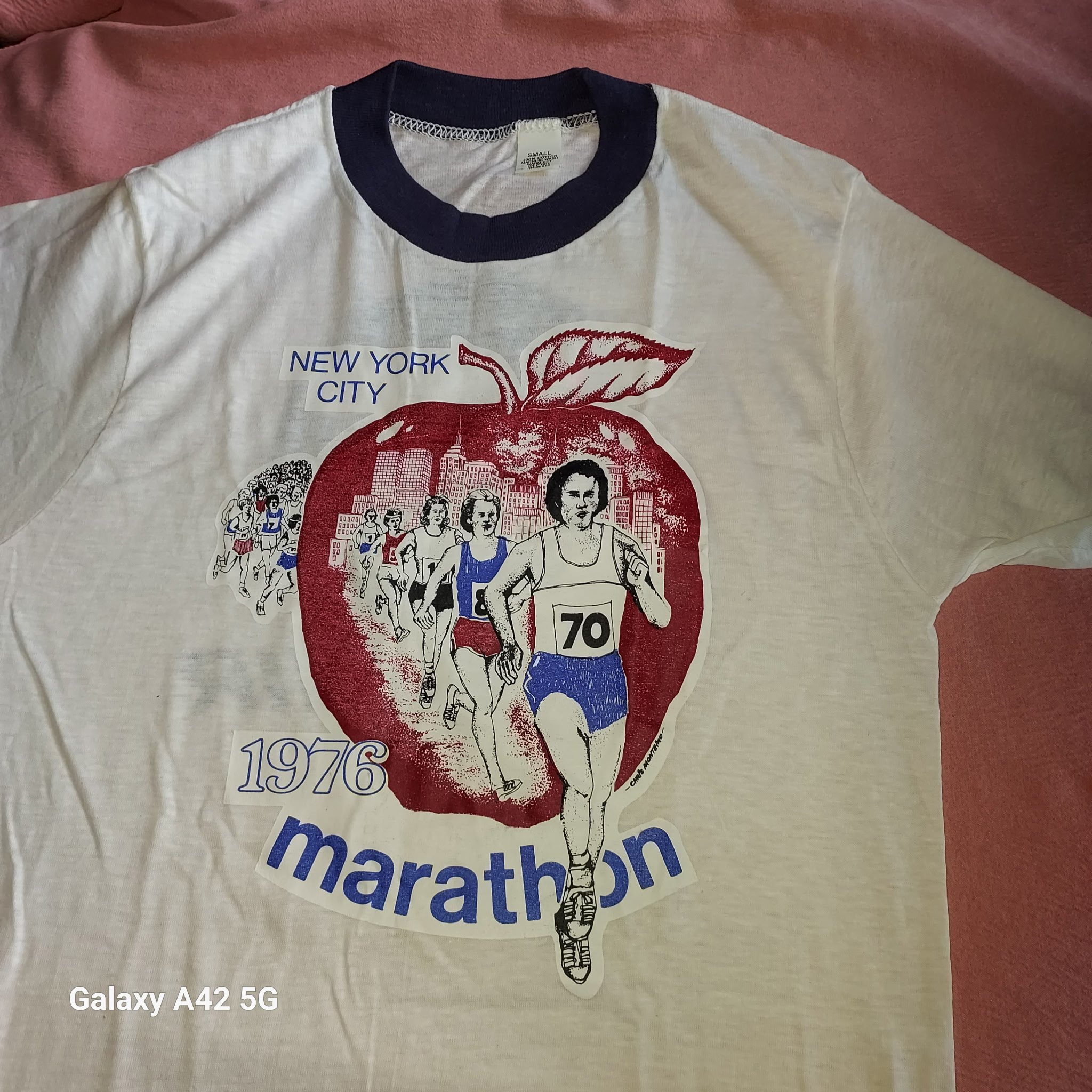
On Saturday I went to the ”Expo” in the auditorium at the Westside Y which housed the NYRRC’s office (a couple rooms on an upper floor) to pick up my number and my swag. Actually, the swag was pretty neat - my first race t-shirt and a LP record with all NYC themed songs.
The Expo lasted a couple of hours, had some speakers and some elite runners were there to chat with. It was nowhere near the current three day extravaganza. I was able to get the autograph of the eventual winner, Bill Rodgers, on the record cover. Several years ago I donated it to the NYRR.
Race Day
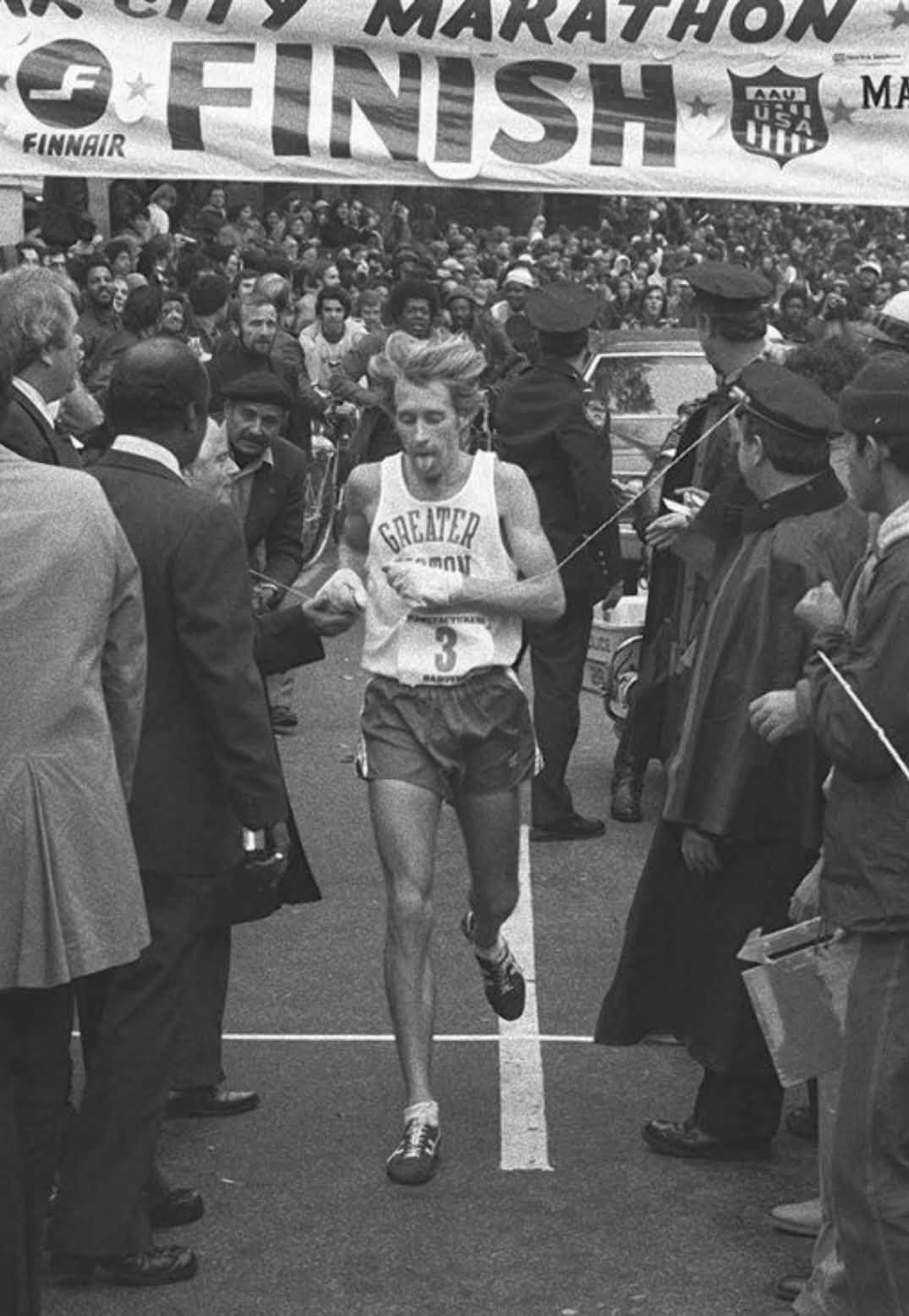
Bill Rodgers winning the 1976 New York City Marathon (Photo posted by Nobby Hashizume on Facebook)
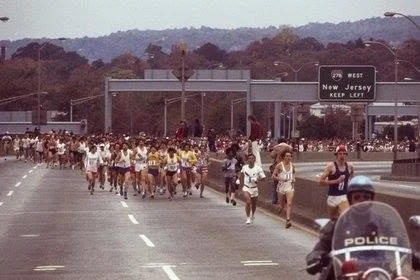
Photo Credit: NYRR as posted on Facebook
October 24th finally arrives. Here’s where the then and now comparisons really start to get crazy. Remember it was a different world.
I know getting to the race now is probably the most stressful part of your race preparation especially if you're in a later wave. Truthfully, I don’t how you manage having to wait hours before you start, I would have been a basket case. Of course, the terms “waves” and “corrals”, were completely unknown and would have puzzled the 2090 starters back then. Little did we know what was to come!
At 8AM on race day morning, my college roommate, Joe Alves, picked me up at my apartment in Manhattan where I had moved to earlier in October. We leisurely drove to Staten Island where he was able to park his car and join me at Fort Wadsworth. He also was able to stay with me at the starting area almost until the 10:30 start. He subsequently returned to Manhattan, parked his car on the East Side and watched me come off the 59th Street Bridge. After I came by he drove to Central Park, found parking again and watched the finish. Truly unbelievable!!
The weather was runner perfect. Temps in the forties with cloud cover but no rain. It was one of those days that was great for the runners, but not so comfortable for the spectators. I believe I wore a $25 pair of Adidas.
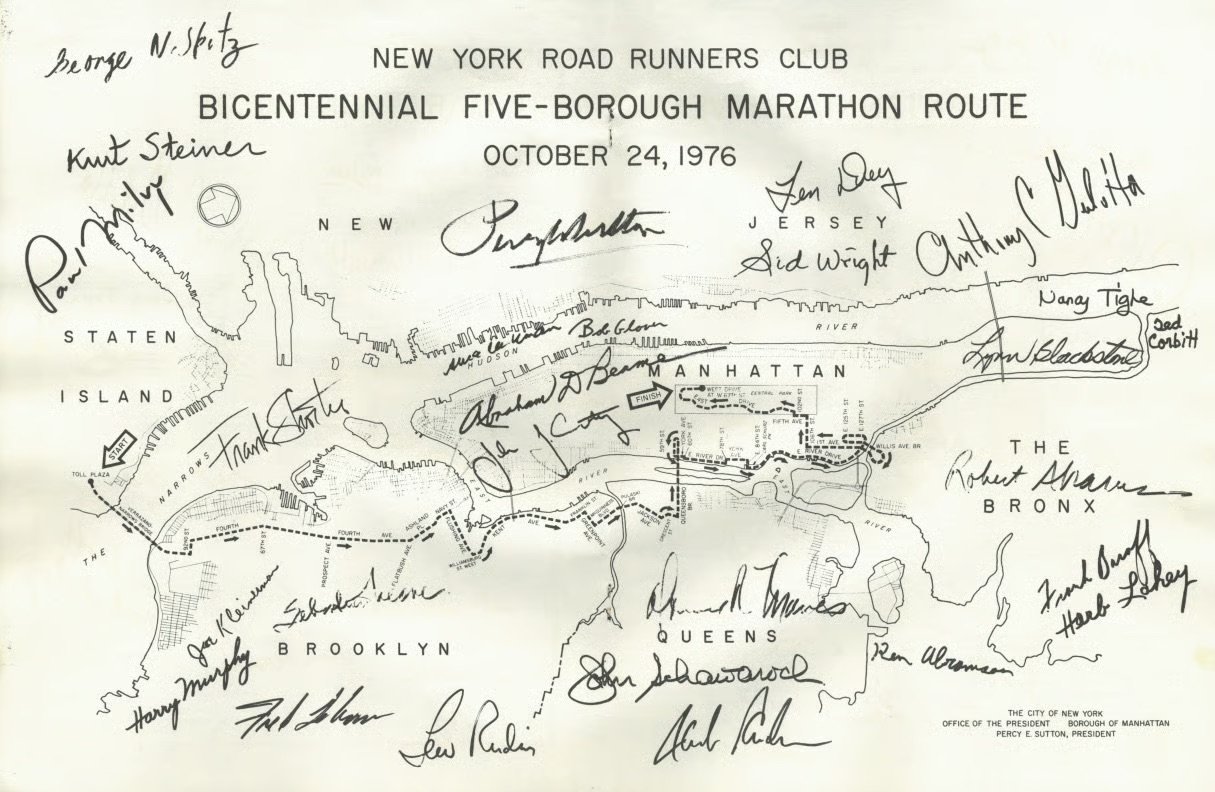
976 NYCM course map, signed by the members of the Marathon Committee, as featured in the marathon program distributed to entrants (Provided by George Hirsch and New York Times Magazine, published by NYRR)
The course that Harry designed was similar to today’s course for the first seven miles. After that I remember it going through the Brooklyn Navy Yard through Williamsburg to the Pulaski Bridge and then across the 59th Street Bridge and into Manhattan. Here is the biggest difference: No First Avenue!! Apparently the city would not close First Avenue, so we went up the the East River Esplanade - a narrow pathway between the FDR and the river. With no spectators it got pretty lonely and I who had run a pretty even race up until then had to walk. Mercifully I got running again. We crossed the Willis Ave Bridge and swung around a lamppost in The Bronx and headed back to Manhattan. We came down Fifth Avenue and into the park only to exit at Central Park South. We reentered the park at Columbus Circle and onto the finish line at Tavern on the Green.
What was it like on the course versus today? Different for sure. There were many spectators (500,000) but nothing like today’s 2,000,000! There were water stations every two or three miles. But only water, no Gatorade, no gels (they hadn’t been invented yet) and certainly no banana stops. If you wanted to run with music you used a Sony Walkman with earphones. Not AirPods. Selfies? Not for another 25 years. As a matter of fact, Steve Jobs had just founded Apple earlier that year.
The race timing was entirely by hand. Amazing when you think about it. Today’s chip based timing was at best light years away. I used my every day watch to track my time! Not even a Casio and certainly not a GPS watch.
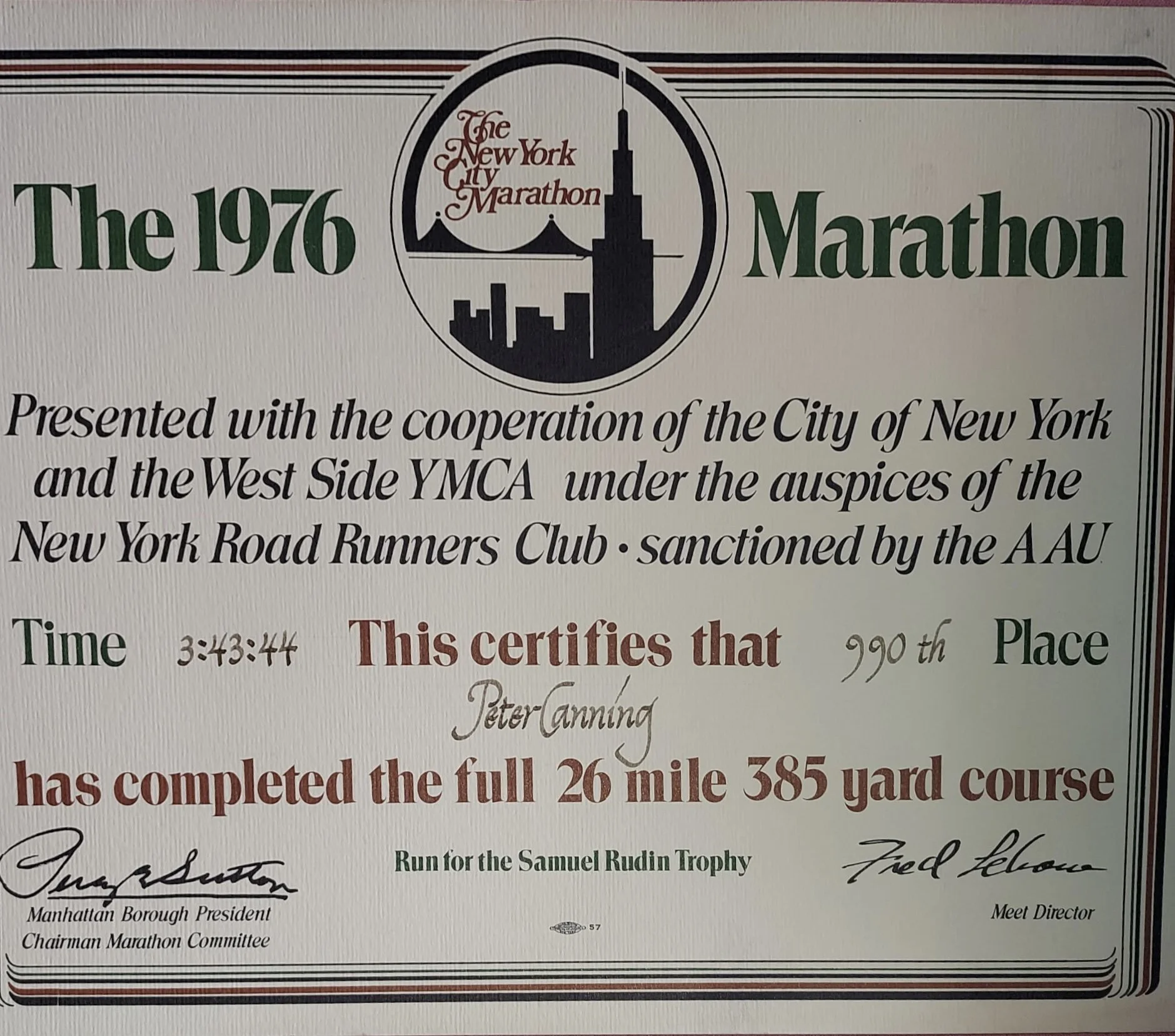
I do remember finishing tired and chilled but smiling like crazy. The finish was beyond exhilarating. Pure bliss!! My time was 3:43. But the time was secondary, my journey was over. I did it. I would have it forever.
Text by: Peter Canning (he/him)
Photos by Peter Canning, unless otherwise noted
Produced and Edited by: Linda S. Chan (she/her)
PPTC is a diverse and supportive team. We want to celebrate the diversity of our club and membership. We welcome and encourage everyone to share their stories with us.